So. You've got the leading video automation platform on your side. But what stories are you going to tell? Dip into our community blog for ideas, inspiration and plenty of handy how-tos.

June 27, 2024
June 27, 2024
Join our upcoming webinar: 2025 content planning made easy: From concepts to calendar
In this article, we’ll explore the magic behind listicles—those simple yet effective tools that turn information into engaging, bite-sized pieces.
We’ll unpack why they work so well, share practical tips, and offer real-life examples to help you use them effectively, whether you’re writing, presenting, or posting on social media.
So, what’s a listicle? It’s not just any list; it’s more like telling a story in list form.
A listicle has a clear structure with bullets or numbers to organize information, but it goes a step further by adding explanations or comments for each item. This format not only organizes details but also gives context, making complex topics much easier to digest.
That’s why listicles have become so popular—they make information quick to read, easy to scan, and fun to follow.
Listicles originated in the early 2000s when the words "list" and "article" were combined to create this catchy term. Traditional articles with long paragraphs lost some of their appeal as the internet became more popular and listicles became a solution because they are short, reader-friendly, and visually appealing.
Websites like BuzzFeed and Cracked gained fame by creating entertaining lists on various subjects, such as "10 Ways to Boost Your Productivity" or "15 Funny Cat Memes to Brighten Your Day."
However, today, the term "listicle" isn't limited to just articles. It can be applied to a wide range of formats. Whether you're writing an article, making a presentation, or crafting a social media post, they can be a versatile and effective tool for getting your message across.
Ever wondered why lists have such a strong hold on our brains?
Well, it's not just chance—it's science! Our brains have an innate love for order and categorization, and lists deliver exactly that. This fascination with lists goes way back, deep into our evolutionary past, making them a natural fit for our cognitive processes.
Here’s why:
Listicles aren’t just for articles; they’re flexible enough to be used across different platforms and formats. Here’s how we use them in various contexts:
We often dedicate entire blog posts to listicles, like our recent one "11 reasons why you should be creating more video." Sometimes, we even use lists within longer articles to break down complex details. If something feels unclear, turning it into a structured list can instantly make it easier to understand.
Our rule of thumb? If something seems unclear, we transform it into a structured list – it's that straightforward.
.jpeg)
Listicles also work well on social media, where short, punchy content grabs attention. We use lists to share key ideas or repurpose parts of articles in engaging formats, like videos.
Here's a tip: try reversing your list for better engagement. Starting with the highest number (like 5) instead of 1 can hook viewers, as they’re curious to find out what ranks at the top.
In a crowded inbox, readers appreciate concise content. That's why we include lists in our newsletters, like this one: How to fuel your content engine: Give your content a second life using video. It helps readers get the essentials quickly, without wading through too much text.

Listicles find their place on our website too. For instance, on our Why Storykit? page, we've presented the main reasons you should use Storykit in a list format, ensuring clarity for our visitors.
.jpeg)
There you have it—from simplifying complex ideas to tapping into the psychology of how we process information, listicles are a powerful tool for communication. Next time you’re aiming to convey ideas in an engaging, easy-to-read format, consider using a listicle. Your audience will thank you for it!

June 19, 2024
June 19, 2024
To make preparing for the summer break as stress-free as possible, I'm sharing my top tips for creating plenty of social media content ahead of time, ensuring your audience stays engaged when the sun is shining.
Planning in advance does take effort, but it pays off. Here is how I fill an entire content calendar before summer begins.

Not everyone sees everything you post, and if they do, then seeing it multiple times is still beneficial. In addition, recycling past posts keeps your feed active without extra effort.
Here is how to do it efficiently:
Last year, I created a majority of my summer content by taking articles written in the past six months, putting them into Storykit AI, and transforming them into short videos.
This approach not only ensures all your new content gets properly distributed, but it's also a highly effective way to create engaging, on-brand content at scale.
Here is how to do it efficiently:
Further reading: 22 ways to repurpose your existing content for social media with video
One of the most effective ways to create content is to work with formats. And this applies to all content, including video. It’s a simple, classic, editorial trick to create a base of content that is quickly produced.
Here are 5 formats you can use to add variation to your summer content plan:
Bonus tip: Make your videos in portrait format since many of your customers and users will be scrolling on the beach, in the hammock, or from the couch. :) Also, make sure to optimize your content for mobile devices.
Further reading: Turn smartphone videos into employer branding content in 3 steps
Even though social media activity dips during the summer, staying consistent and working with the algorithms will not only ensure you stay visible but will also help you gather insights you can use in the fall. Use my tips to batch out a bunch of content, test different strategies, and give your audience something to enjoy even when you're not actively online.

June 17, 2024
June 17, 2024
As technology continues to advance, the intricacy of software systems grows, making it essential for IT (informational technology) companies to find innovative ways to convey their value propositions to clients.
One powerful tool that has emerged in this context is video.
By leveraging video, IT companies can:
This article explores why video is important in the IT industry and how companies can use it effectively, drawing inspiration from successful case studies.
The importance of video in the IT industry cannot be overstated. Here are a few ways it can benefit IT companies:
Videos are a powerful tool for marketing IT products and services. They can demonstrate product features, showcase client testimonials, and explain technical concepts in a user-friendly manner. Engaging video content can attract potential clients, enhance customer understanding, and build trust in the company’s offerings.
Video content is invaluable for providing technical support. IT companies can develop a library of troubleshooting videos that address common issues faced by users. These videos can reduce the load on support teams, provide quick resolutions for customers, and improve overall user satisfaction.
Videos serve as an effective medium for training and development. IT companies can create detailed tutorials and instructional videos that help employees understand complex systems and technologies. This visual approach to learning accelerates the training process, ensures consistency in knowledge dissemination, and can be accessed anytime for refresher courses.
Advenica, a leading cybersecurity company, recognized the advantages of using video in their marketing and communication strategies. Their work is highly technical and dense, with texts that are specific and complex. To address this challenge, Advenica decided to use video to break down these intricate concepts into more accessible content.
Example of video from Advenica:
Using video helped Advenica demystify their highly technical content, making it more accessible and engaging for their target audience. This approach enhanced their communication strategy and contributed to better customer understanding and engagement.
Full case study: Advenica gets more videos for less with Storykit
You’re now aware of the many benefits that video can bring to your IT business. However, you probably don't want to spend time learning how to create videos or actually making them. This is where Storykit comes in. Storykit makes it incredibly easy for anyone to create professional videos without needing any editing experience.
With Storykit, you can take a text, such as a security update or a product description, and effortlessly transform it into a video. You can also add screen recordings and product pictures or stock images from our extensive stock library to enhance the storytelling.
Here’s how IT companies leverage Storykit:
Storykit simplifies the video creation process, allowing IT departments to produce high-quality content without needing specialized skills or extensive time investment. By integrating videos into your IT operations, you can enhance communication, training, and customer satisfaction effortlessly.
In the IT industry, where complexity is the norm, video serves as an invaluable tool for simplifying information and enhancing communication. By adopting video strategies, IT companies like Advenica have successfully improved client understanding and driven sales. As technology continues to evolve, the importance of clear and engaging communication will only grow, making video an essential component of any IT company's toolkit.
By embracing video, IT companies can not only demystify their complex software solutions but also build stronger relationships with their clients, ultimately leading to greater success in a competitive market.

June 10, 2024
June 10, 2024
Here are some expert tips for selecting the best stock assets for your videos and searching for them effectively.
When creating videos, it can be tempting to simply search for assets that match the words you're saying and use the first result, like “marketing person” or “social media feed”.
While this approach might occasionally yield acceptable results, there are several strategies you can employ to enhance the quality of your stock images and significantly improve the storytelling in your videos.
Here are some best practices for using stock assets effectively.
If your video is in the one minute range, aim to use no more than three to four different stock assets. You don't need a new asset for every single topic or point. This helps maintain a cohesive and professional look throughout your video and avoids overwhelming your audience with constant visual changes.
INSTEAD of doing this: Piecing together a lot of different background assets to tell your story...
DO this: Use one or two and drag them across storyboards to create a smooth flow of information.
Select backgrounds and images that are not overly busy. Your visual content should complement your message, not compete with it.
INSTEAD of doing this: Instead of choosing backgrounds with too much action or detail that could distract from the text or main subject of your video...
DO this: Choose calm and serene visuals to help maintain focus and make your content more engaging.
Your assets don’t have to be literal representations of your content. For example, if your video is about the stress of marketing, opt for soothing backgrounds that counterbalance the stressful topic. This contrast can create a more balanced and appealing visual narrative.
INSTEAD of doing this: Using "literal" assets that match what you're saying in your script...
DO this: Choose visuals that support and enhance the story you’re telling. They don’t need to be a literal translation of what you’re saying. They should be consistent with the tone and message of your script.
Always use high-resolution assets to ensure your video looks professional. Poor quality or pixelated images can detract from your credibility and viewer experience.
INSTEAD of doing this: Downloading and inserting low-quality stock assets to your videos...
DO this: Use Storykit's high-resolution stock image library to insert assets directly into your videos, enhancing their visual quality and storytelling impact.
Further reading: Craft engaging videos: The key dos/don'ts for impactful results
To find the best stock assets, use a variety of search terms that align with the themes and aesthetics of your video. Here are some useful keywords to consider:
Adding stock assets to your videos and testing out different ones in normal editing software can be a pain. First, you have to find, download, and save the assets, then you need to upload them and hope they work. If they don’t, you need to start the process all over again. However, Storykit simplifies this process by providing access to a number of high-quality stock libraries, such as:

In Storykit, you can search directly within the tool across all these libraries to find what you are looking for. If an asset is too short in length, it appears in red, so you don’t waste time adding the wrong ones.
Additionally, with Storykit’s AI capabilities, when you generate a video, it will automatically suggest assets that work with your script, saving you from having to start looking from scratch.
Martin Svensson, Communication Manager at Länsförsäkringar, struggled significantly with creating videos due to the lack of readily available assets. They had just started a magazine for their customers, which contained a wealth of material that could be used in educational videos, such as interesting facts about their county and articles to promote Västerbotten. However, the lack of a proper photo library made the process time-consuming and frustrating.
"One of the videos we wanted to make was about snow scooters, but we didn't have any photos of snow scooters in Storuman Municipality. I played with the idea of building a photo library with our photographers, but the IT department warned that it would be difficult to control the security of such a library. At that point, I was almost ready to give up on my video efforts."
That’s when Martin came across Storykit. He explains:
"I received a demo and quickly realized that Storykit had all the features we needed, plus a really good photo library."
Read full case study: How Sweden's largest insurance company increased its video production by 300%
By leveraging tools like Storykit, you can streamline your workflow, ensure high-quality results, and focus more on crafting compelling video content rather than getting bogged down in the technicalities of asset management.

June 10, 2024
June 10, 2024
In a new integration, Storykit, the leading video creation tool, is joining forces with Getty Images, a preeminent global visual content creator and marketplace, to equip content creators with an extraordinary library of over 14 million creative assets.
Getty Images is renowned for its diverse, fully model-released selection of unique and compelling videos.
By integrating Getty Images’ content into Storykit's easy-to-use platform, users can now access this vast library without leaving their workspace, significantly saving time and boosting productivity.
Finding the right assets for your text-driven video is an important ingredient in creating thumb-stopping stories for your audience. This collaboration will help streamline and elevate this process.
– We’re happy to implement Getty Images’ innovative search functionality, that helps both the user and the AI to find the perfect visual assets to accompany every video, ensuring content that resonates with viewers, says Fredrik Strömberg, CPO at Storykit.
– By marrying Storykit's innovative text-to-video technology with Getty Images' impressive catalog, we are setting a new standard for creativity and storytelling. This integration not only streamlines the video creation process but also elevates the quality of content that organizations of any size can produce, proving that with the right tools, everyone has a story worth telling, says Peder Bonnier.

June 3, 2024
June 3, 2024
Welcome to the world of talking head videos. You've seen them all over social media. Now it's your turn to create them, and we’re going to show you how.
Talking head videos are videos that feature a person speaking directly to the camera, typically with little to no visual aids. Talking heads are a common format on professional social media platforms like LinkedIn, where individuals leverage them to showcase expertise, establish thought leadership, share testimonials and connect with their professional networks.
Talking head videos are a great addition to your social media feed for a few reasons:
Overall, incorporating talking head videos into a company's marketing and branding strategy can contribute significantly to brand building efforts, fostering trust, loyalty, and engagement with customers and stakeholders.
Now you are ready to get started. Here’s how you can add talking heads to your videos seamlessly with Storykit.
Forget about transcribing issues, volume inconsistencies, text alignment headaches, and the hassle of adding B-roll. Here’s the secrets.
You can do this in two ways:
1. Repurpose online interviews (webinars, podcasts, etc.): With this method, your footage is obviously already all recorded and ready to go. For example, you could use a podcast recording, webinar footage, etc.
2. Record yourself or another person talking: Other guides might tell you about finding a nice backdrop or using expensive equipment. If you’re into that, feel free to explore those options. But for this guide, just find some nice lighting, grab your phone, and capture a good quote or say something interesting. Forget the complications for now—you can dive into those (not necessarily essential) elements later.
Once you upload your footage to Storykit, the AI will automatically transcribe and edit everything for you. This is a huge relief compared to the pains of traditional editing software. Even though the AI is often impressively accurate, you still have the option to read through your script and correct any misspelled words.
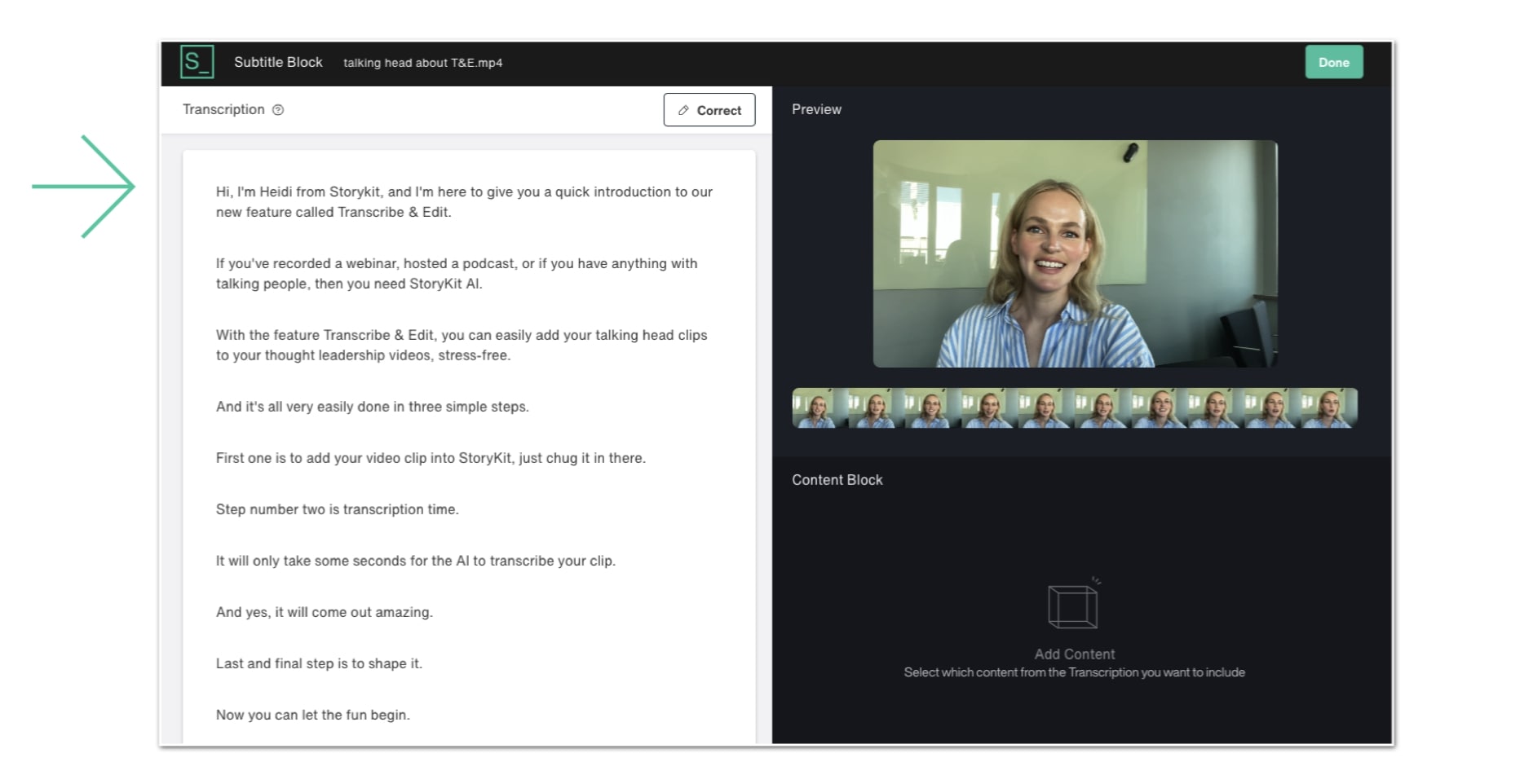
Here comes the real magic: you choose which parts of the text (or the words) you want to include and seamlessly stitch them together, allowing you to craft your narrative effortlessly. Just drag and drop.
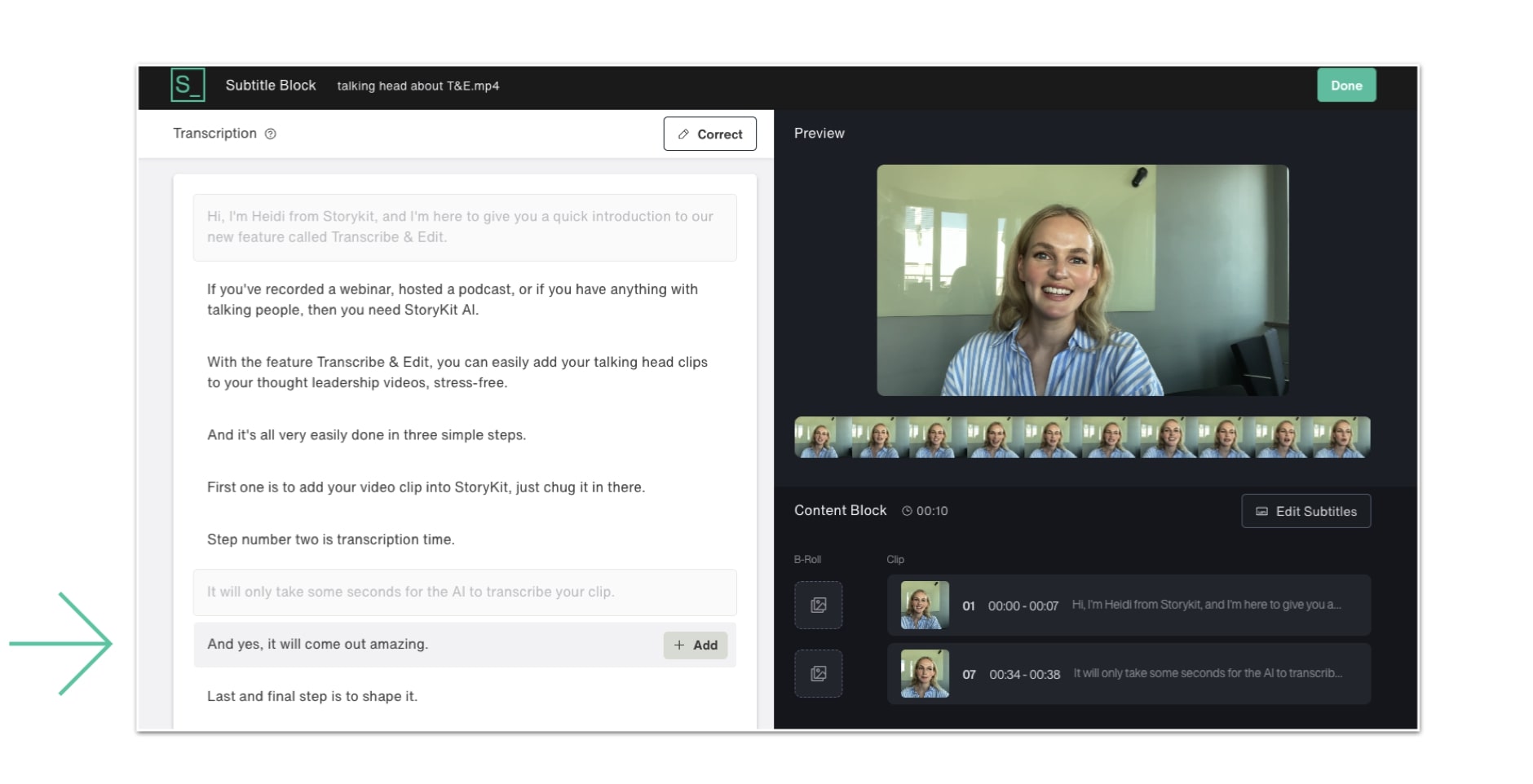
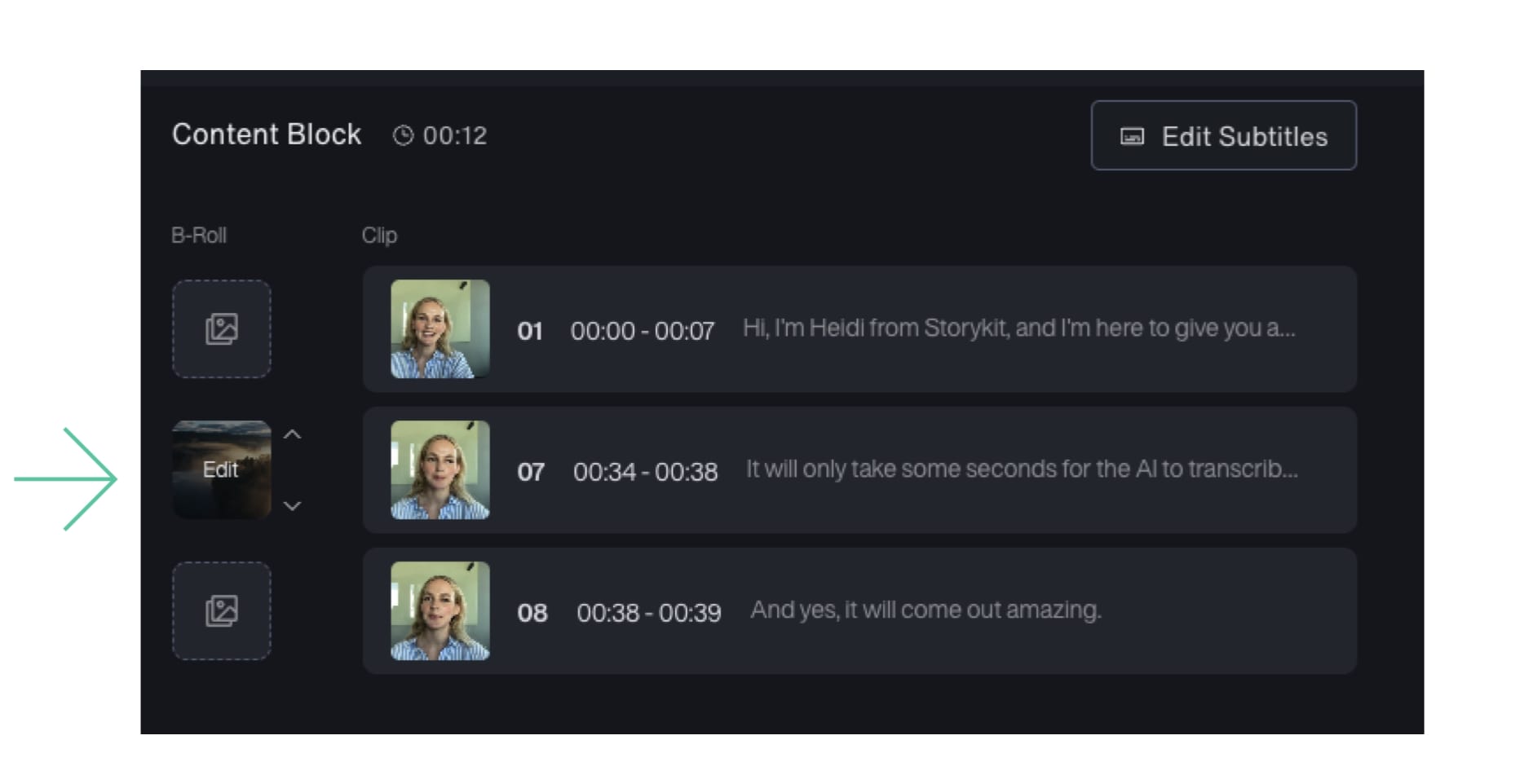
Ever heard of B-roll? That's the extra footage in videos that fills out the story, showing scenes and details that aren't the main footage of the person talking but help paint a fuller picture. If you want to add B-roll to your video, you can drop in clips at the places you want them to appear. For instance, while our Community Manager talks about about transcription feature, we can add a video of what she is talking about, adding depth and context to the discussion.
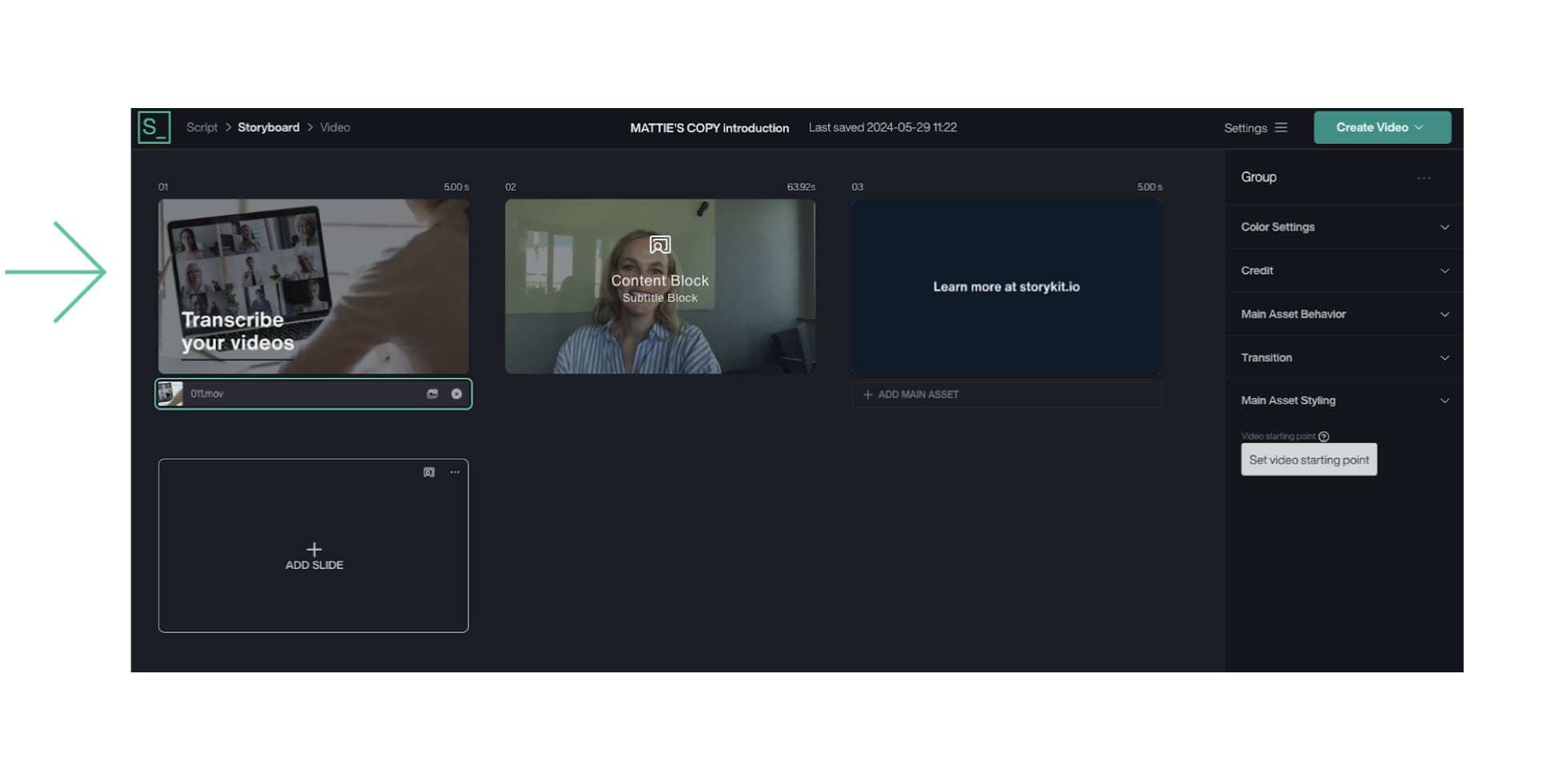
With your talking head clip prepared, you're ready to seamlessly integrate it into your video. Whether you're starting with your logo and a catchy tagline, weaving a dynamic long-form narrative, or concluding with a compelling call to action, Storykit offers dynamic ways to craft your complete story.
If you want to, you can also add a touch of background music to enhance the mood of your video. Don't worry about the volume—Storykit automatically adjusts it for you, ensuring that the music complements the spoken content without overpowering it.

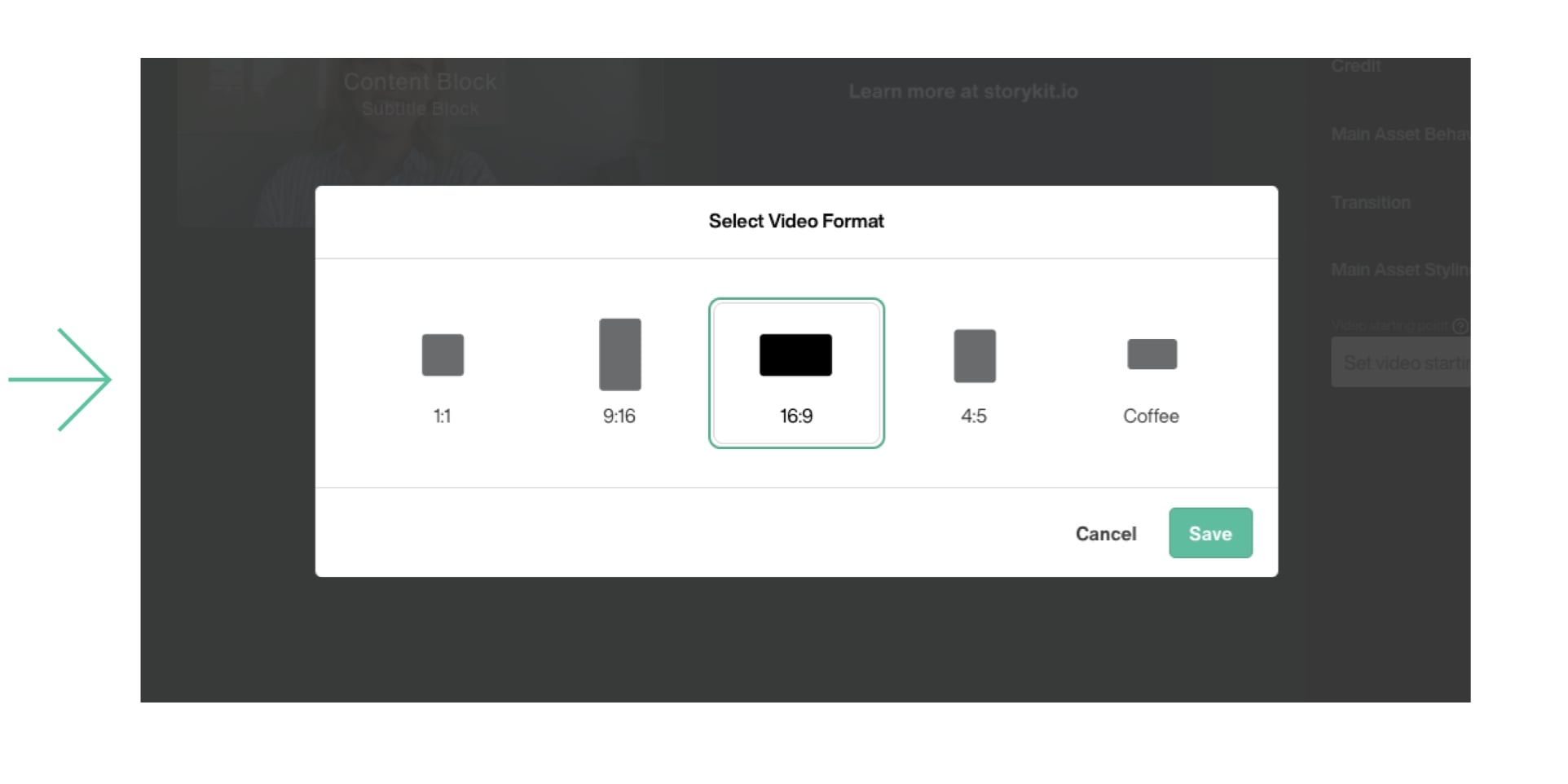
Export your video in the correct dimensions for whichever platform you're using. Whether it's YouTube, Facebook, Instagram, or any other, Storykit makes it easy. There’s no need for additional editing or reformatting. Simply choose your platform, and we handle the rest, ensuring your video looks perfect no matter where it’s viewed.
Do you have talking head clips ready to share on social media? Don't wait any longer. We're here to help you get started and make the process smooth and simple. Let's bring your content to life.
We’ve teamed up with Daniel Bromberg, paid ads expert at LinkedIn, to give you the ultimate playbook on LinkedIn video ads.


Need videos for social media, sales, HR, or internal communication? With Storykit, any team can create professional videos. These videos can match their brand and work for any platform, format, or language. No editing skills are needed. Whether for LinkedIn, corporate presentations, or global campaigns, Storykit ensures your videos are engaging and optimised for impact.
It’s that time of year again—when we all start scrambling for ideas and templates to piece together our social media plan for the new year. Trust me, I’ve been there too. The endless Googling, the overcomplicated strategies… it can get overwhelming fast.
That’s why we're here to make it easy for you. We're giving you our social media plan for 2025—complete with all the resources and tips to help you nail it without the stress. Ready to steal it?